

Warehouse automation implementation doesn’t have to be risky. This guide shows how to overcome common challenges with a phased plan, tighter WMS integration, and measurable ROI.
Warehouse automation implementation promises speed, accuracy, and resilience. However, warehouse automation implementation can stall when plans skip change management, data readiness, or WMS connectivity. This guide breaks down seven common hurdles and gives you field-tested fixes, so your warehouse automation implementation delivers results fast.
Why it happens: Teams struggle to connect use cases to hard numbers. As a result, stakeholders hesitate.
How to solve it:
Start with a pilot that measures throughput, accuracy, and hours saved. Tie each KPI to business impact.
Use a costed roadmap. Include capex, integration, training, and ramp-down of legacy processes.
Benchmark and validate. External research helps set expectations (see MHI Annual Industry Report 2025 and McKinsey’s guidance on getting automation right).
Helpful Liftians resources: Validate assumptions with our Performance Metrics and build the business case using the Liftians Whitepaper.
Why it happens: Interfaces, data models, and master data aren’t aligned. Consequently, exceptions explode.
How to solve it:
Map events early. Define orders, tasks, priorities, and confirmations between WMS and automation.
Create a sandbox. Test error paths, reassignments, and edge cases.
Use open, well-documented APIs. Fewer custom hacks mean faster upgrades.
Helpful Liftians resources: Explore how our Software platform integrates real-time monitoring and MapMonitor for clear orchestration. For deeper assets and demos, see the Info Portal.
Why it happens: Automation changes roles, habits, and floor choreography. Therefore, resistance rises.
How to solve it:
Communicate “why, how, when.” Share the north star and timeline in simple language.
Upskill fast. Short task-based training, then certify.
Delegate champions. Appoint super-users in each area to coach peers.
Helpful Liftians resources: Our Service & Support, program includes training, total care, and lifetime spare parts coverage to keep teams confident.
Why it happens: Facilities weren’t designed for robots. Moreover, ramps and tight aisles complicate flows.
How to solve it:
Survey and simulate. Capture grades, clearances, floor conditions, and congestion hot spots.
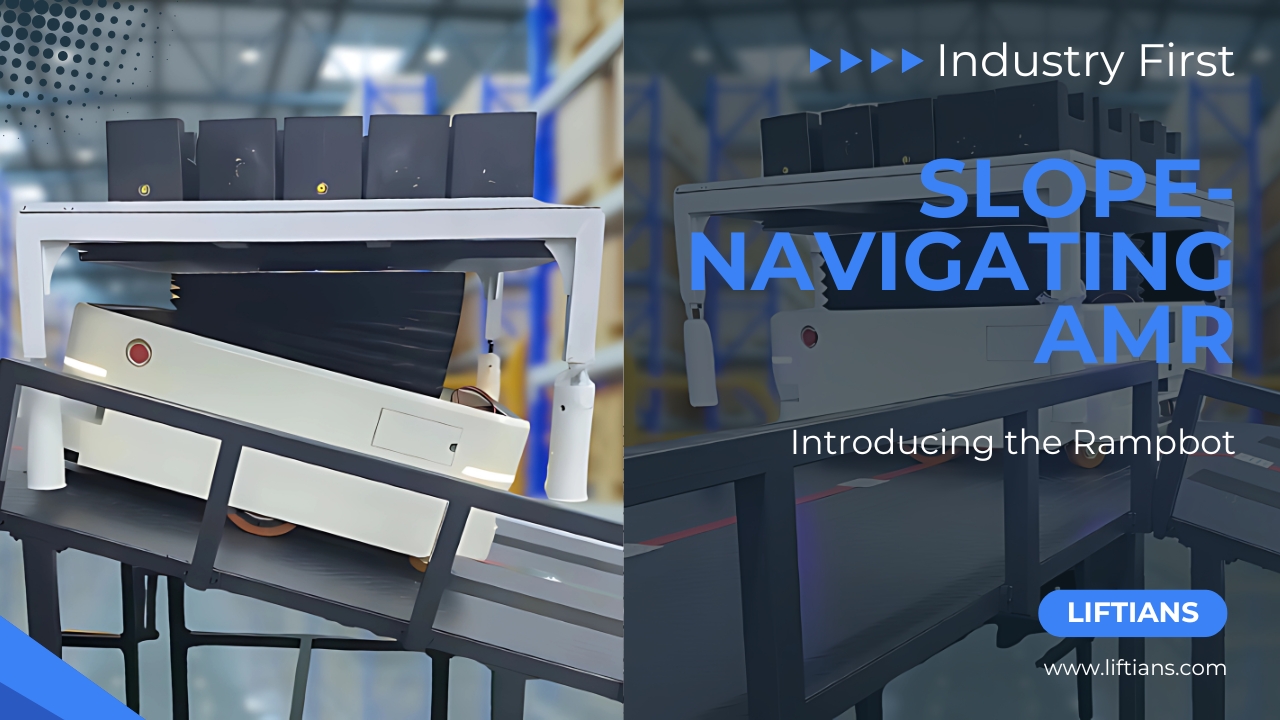
Match solution to terrain. Consider incline-capable AMRs and forklift-free flows for safety.
Re-slot and re-mark. Simple layout tweaks often unlock big throughput.
Helpful Liftians resources: Review our Hardware capabilities and deployment footage in the Info Portal.
Why it matters: Injury risks increase with mixed fleets and higher velocity. However, design reduces risk.
How to solve it:
Design for people first. Separate pedestrian and vehicle lanes. Add visual cues and geofences.
Go forklift-free where feasible. AMR routes and goods-to-person stations reduce exposure to high-risk maneuvers.
Train continuously. Reinforce rules after every process change.
External perspective: See NSC Injury Facts on forklift incidents and broader OSHA analyses to inform your plan.
Helpful Liftians resources: For system-level safety and compliance, lean on our Service & Support and asset library in the Info Portal.
Why it happens: Inaccurate SKUs, hazmat flags, dimensions, or slotting rules create chaos.
How to solve it:
Audit your master data. Validate dimensions and handling rules before the pilot.
Tidy priorities. Standardize wave rules, batching, and exception codes.
Instrument everything. Use logs and dashboards to catch drift early.
Helpful Liftians resources: Our Software provides real-time monitoring that surfaces faulty signals quickly.
Why it happens: Cross-functional projects lack a single accountable lead. Consequently, decisions slow.
How to solve it:
Assign one program owner. Give them authority across IT, ops, safety, and facilities.
Use a phased plan with gates. Pilot → stabilize → expand.
Lock a realistic schedule. Visual timelines create alignment.
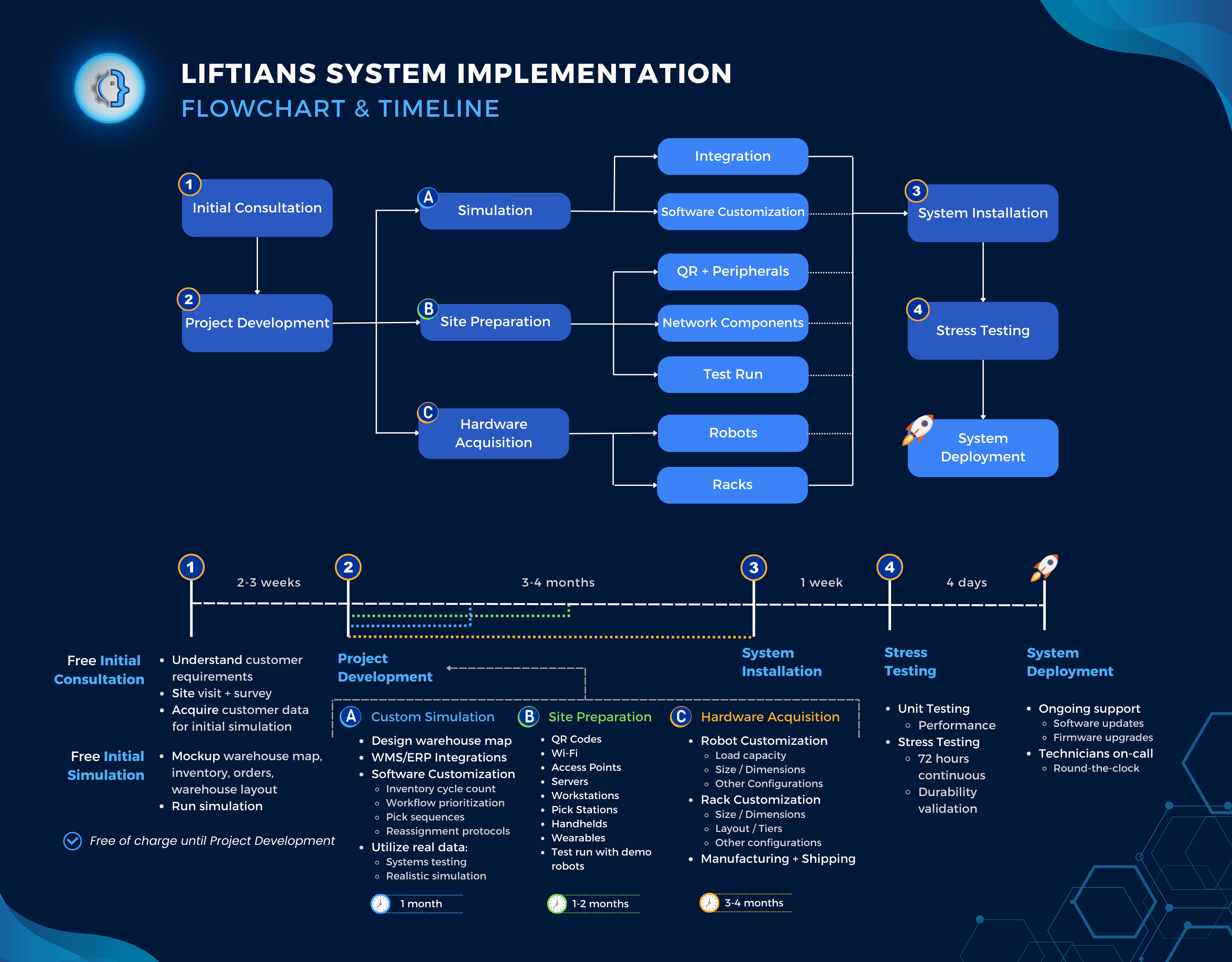
Helpful Liftians resource: Download the Implementation Flowchart & Timeline to structure your warehouse automation implementation.
A successful warehouse automation implementation feels predictable. You set phases, integrate cleanly with WMS, manage change, and design for people. Then you scale with confidence. Use this playbook, lean on the resources above, and your warehouse automation implementation will deliver measurable, durable impact.
Warehouse automation is shaping the future of supply chains. From robotics to AI, discover the benefits, challenges, and solutions redefining efficiency.

Liftians focuses on system-first automation — our AMRs adapt to your existing warehouse layout instead of forcing costly infrastructure changes. This means faster ROI, minimal disruption, and solutions customized to your operation’s exact needs.
Yes. Our RampBot is designed to safely transport pallets and shelving units on inclines up to 15° while maintaining stability and load control. This is especially valuable for facilities with outdoor loading docks or uneven terrain where traditional AMRs struggle.
We work with 3PLs, retailers, manufacturers, and healthcare distributors across North America. Whether you move cases, pallets, or mixed-SKU totes, Liftians customizes its robots and software for your workflow.
We provide a no-cost consultation to review your current workflows, labor challenges, and facility layout. You’ll receive a high-level automation fit report outlining where AMRs can save costs, increase throughput, and shorten cycle times.
Most clients see ROI in 6–12 months, with pick rates improving 3–5x and labor costs reduced by 40–70%. Because our AMRs adapt to your existing layout, you avoid expensive reconstruction delays that slow down ROI with other systems.
Our AMRs use QR-code navigation, AI-driven routing, obstacle avoidance, and smart charging. The software suite includes BotService, AdminTool, Station UI, and MapMonitor — giving operators live visibility into performance, inventory, and WIP.
No. Liftians does not charge when you add more robots or platforms. Costs only apply for major layout changes, site visits, or third-party integrations unrelated to our system (e.g., changing Wi-Fi providers).
We provide uptime guarantees and SLAs that match or exceed industry standards. Resolution times are tailored per deployment but are always defined clearly before project launch to give you predictable performance.
We actively partner with consultants who have direct connections to distribution centers, retailers, or manufacturers. Consultants gain access to our engineering team, demo content, and pilot programs to help bring automation opportunities to their clients.