
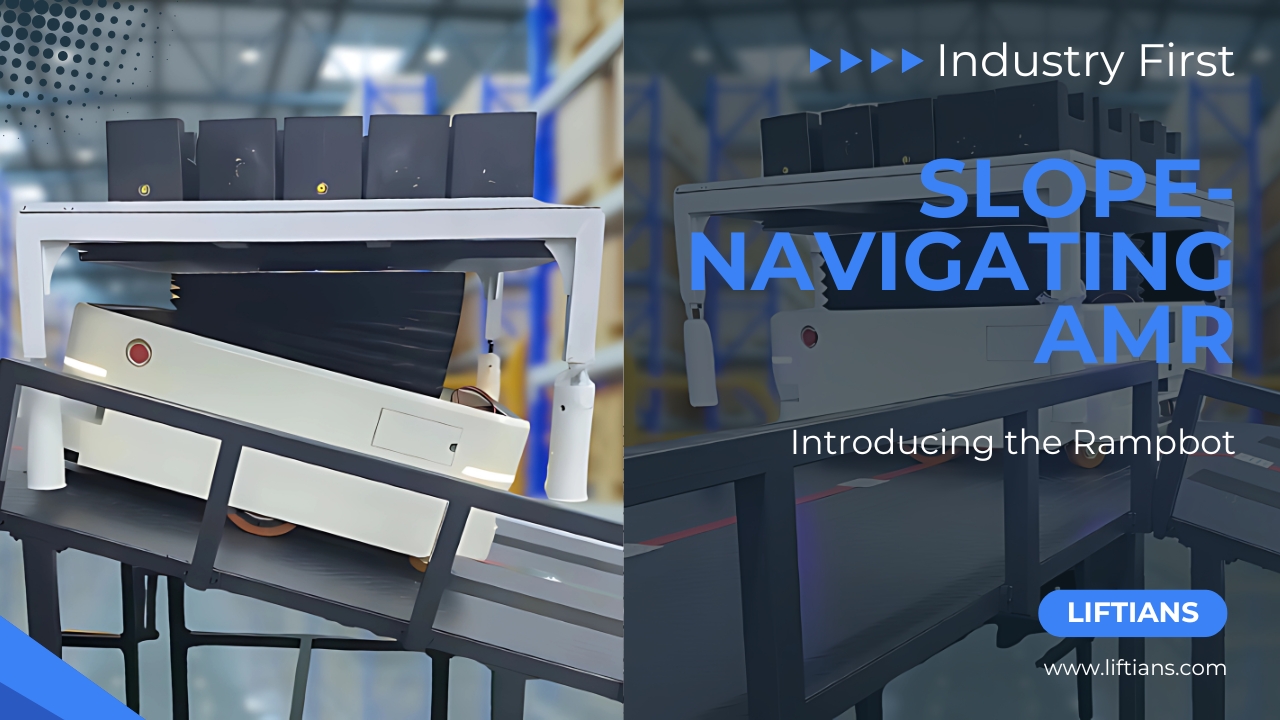
Liftians introduces RampBot — the industry’s first slope-navigating AMR, engineered to conquer ramps and inclines with safety, power, and precision. Debuting at ProMat 2025.
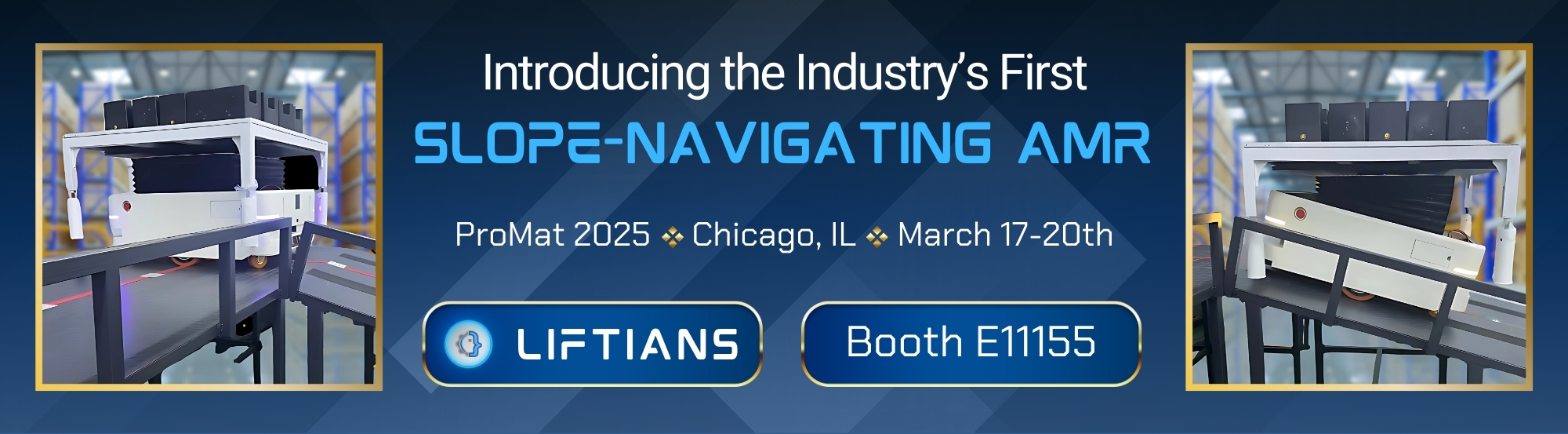
Liftians is proud to announce the launch of RampBot, the industry’s first slope-navigating AMR designed for real-world warehouse challenges. Officially debuting at ProMat 2025 (Booth E11155), RampBot unlocks new levels of safety, productivity, and ROI for facilities that rely on ramps, docks, and uneven floors.
Moving goods across inclines has always been a challenge in warehouses and factories. Traditional forklifts often struggle on ramps, leading to delays and safety concerns. However, the rise of slope-navigating AMRs is transforming how businesses handle ramp operations. These robots offer a safer, smarter, and more cost-effective forklift alternative for ramps, helping companies modernize their workflows.
Forklifts are built for flat surfaces. On ramps, they face reduced stability, higher accident risks, and slower operation. According to OSHA forklift safety data, tip-overs remain one of the leading causes of warehouse injuries. As a result, workers require extra training, and productivity often suffers. In addition, ramps continue to be one of the most accident-prone areas in any facility. Therefore, many companies are now looking for reliable slope-capable forklift replacements.
Unlike forklifts, slope-handling AMRs use advanced sensors and smart navigation to detect angles and adjust movement automatically. For example, a ramp navigating AMR can carry heavy pallets while keeping them stable, even on steep inclines. More importantly, these incline-capable AMRs operate consistently without fatigue, which improves both safety and efficiency.
Furthermore, industry research confirms their value. A LogisticsIQ report on warehouse automation predicts strong growth for AMRs as companies seek safer and more efficient incline transport solutions. Therefore, adopting slope-capable AMRs help future-proof warehouse operations.
Most AMRs excel on flat floors but stop short when ramps appear. Forklifts or manual labor fill the gap, creating inefficiency and safety risks. RampBot changes that:
Payload strength: Up to 3,300 lbs on flat floors (adjusts dynamically on slopes).
Stable incline performance: Maintains 2 m/s speed on ramps with adaptive drive systems.
Precision handling: Self-balancing sensors + dual lifting mechanisms keep loads secure.
Safety first: They lower the chance of accidents caused by forklift instability.
Higher productivity: Ramp-capable AMRs move goods day and night with minimal downtime.
Flexibility: They adapt to ramps, aisles, and docks, unlike forklifts that need level flooring.
Cost savings: Businesses save on training, insurance, and forklift maintenance.
In addition, slope automation robots integrate easily with warehouse management systems. As a result, companies achieve smoother dock-to-shelf workflows while reducing forklift reliance. As McKinsey highlights in their logistics automation report, automation is a key driver of safety and productivity across the supply chain.
RampBot isn’t just about inclines—it’s about full-scale adaptability:
Supersized options for higher payloads.
Weather-proof build for outdoor-to-indoor operation.
Seamless integration with Liftians’ software suite (BotService, AdminTool, MapMonitor).
📍 Booth E11155 — come see RampBot live in action.
The slope-navigating AMR is more than an innovation; it’s a new standard for safe, efficient, and adaptable warehouse automation.

Liftians focuses on system-first automation — our AMRs adapt to your existing warehouse layout instead of forcing costly infrastructure changes. This means faster ROI, minimal disruption, and solutions customized to your operation’s exact needs.
Yes. Our RampBot is designed to safely transport pallets and shelving units on inclines up to 15° while maintaining stability and load control. This is especially valuable for facilities with outdoor loading docks or uneven terrain where traditional AMRs struggle.
We work with 3PLs, retailers, manufacturers, and healthcare distributors across North America. Whether you move cases, pallets, or mixed-SKU totes, Liftians customizes its robots and software for your workflow.
We provide a no-cost consultation to review your current workflows, labor challenges, and facility layout. You’ll receive a high-level automation fit report outlining where AMRs can save costs, increase throughput, and shorten cycle times.
Most clients see ROI in 6–12 months, with pick rates improving 3–5x and labor costs reduced by 40–70%. Because our AMRs adapt to your existing layout, you avoid expensive reconstruction delays that slow down ROI with other systems.
Our AMRs use QR-code navigation, AI-driven routing, obstacle avoidance, and smart charging. The software suite includes BotService, AdminTool, Station UI, and MapMonitor — giving operators live visibility into performance, inventory, and WIP.
No. Liftians does not charge when you add more robots or platforms. Costs only apply for major layout changes, site visits, or third-party integrations unrelated to our system (e.g., changing Wi-Fi providers).
We provide uptime guarantees and SLAs that match or exceed industry standards. Resolution times are tailored per deployment but are always defined clearly before project launch to give you predictable performance.
We actively partner with consultants who have direct connections to distribution centers, retailers, or manufacturers. Consultants gain access to our engineering team, demo content, and pilot programs to help bring automation opportunities to their clients.